


There’s nothing quite like settling in for a cozy evening at home, only to be jolted by mysterious clanging, banging, or whistling from your heating system. If you’ve been wondering “why is my heater making noise,” you’re not alone and the good news is that most noisy heater issues have straightforward solutions.
Whether you have an electric or gas heating system, unusual sounds are your heater’s way of communicating that something needs attention. Some noises are simple fixes you can handle yourself, while others signal it’s time to call in a professional. In this comprehensive guide, we’ll decode every clank, rattle, and hum so you can restore peace and quiet to your Tempe home.
Understanding Common Heater Noises: What’s Your System Trying to Tell You?
Every heating system has its own language, and learning to interpret these sounds can save you money, prevent breakdowns, and extend your equipment’s lifespan. Let’s break down the most common heater noises and what they actually mean.
Banging or Booming Sounds
That loud BANG that makes you jump? It’s usually caused by one of these culprits:
Metal expansion and contraction – As your ductwork heats up and cools down, the metal expands and contracts. This is especially common in homes with undersized ducts or poor installation. The metal literally “pops” as it adjusts to temperature changes.
Dirty burners in gas heaters – If you’re wondering why your gas heater is making noise, dirty burners are often the answer. When gas burners get clogged with dirt and debris, gas can build up before igniting all at once, creating that startling boom. This is sometimes called “delayed ignition” and requires immediate attention for safety reasons.
Loose ductwork – Sections of your ductwork that aren’t properly secured can slam against each other or the framing when air suddenly rushes through them.
Rattling or Vibrating Sounds
A rattling noisy heater typically points to:
- Loose screws, panels, or mounting brackets – Over time, vibration can loosen hardware throughout your heating system
- Debris in your ductwork – Small objects, construction materials, or even children’s toys can fall into vents and rattle around
- Loose blower wheel – The fan that circulates warm air through your home can become unbalanced or loose
- Failing motor mounts – Worn rubber mounts that cushion your blower motor can deteriorate
Humming or Buzzing Sounds
Wondering why your electric heater is making noise? Humming is particularly common in electric systems:
- Electrical issues – Loose wiring, failing capacitors, or problems with the transformer can all create buzzing sounds
- Blower motor strain – An overworked motor often hums louder than normal
- Loose components vibrating – Even small parts can create a persistent hum when they vibrate at certain frequencies
Squealing or Screeching Sounds
This high-pitched sound is hard to ignore and usually means:
- Worn blower motor bearings – As bearings dry out or wear down, metal rubs against metal, creating that fingernails-on-chalkboard sound
- Belt issues – If your system uses a belt-driven blower, a loose, worn, or misaligned belt can squeal
- Damaged blower wheel – Bent or broken fan blades can scrape against the housing
Clicking Sounds
Occasional clicking when your heater starts up is normal. However, persistent clicking could indicate:
- Failing ignition system – Your gas heater’s igniter might be struggling to light the burners
- Relay problems – Electrical relays that control your system can fail and click repeatedly
- Thermostat issues – A malfunctioning thermostat might be trying to signal your system incorrectly
Why Is My Heater Making Noise When It’s Off?
This is one of the most unsettling situations homeowners face. You’ve turned off the heat, but your system is still making sounds. Here’s what’s likely happening:
Cooling Down Process – Even after your heater shuts off, the ductwork continues to cool, causing popping or ticking sounds. This is completely normal and should stop within 15-30 minutes.
Trapped Air in Hydronic Systems – If you have hot water or steam heat, air bubbles trapped in the pipes can cause gurgling or banging even when the system isn’t running.
Expansion Tank Problems – A failing expansion tank in a boiler system can cause intermittent banging sounds.
Stuck Dampers – Automatic dampers that control airflow might stick in partially open positions, causing whistling sounds as air moves through gaps.
Thermostat Still Calling – Your thermostat might be malfunctioning, sending signals to your system even though it shouldn’t be running.
If your heater makes noise when it’s off consistently, it’s worth having a professional investigate to rule out any serious issues.
Why Is My Electric Heater Making Noise?
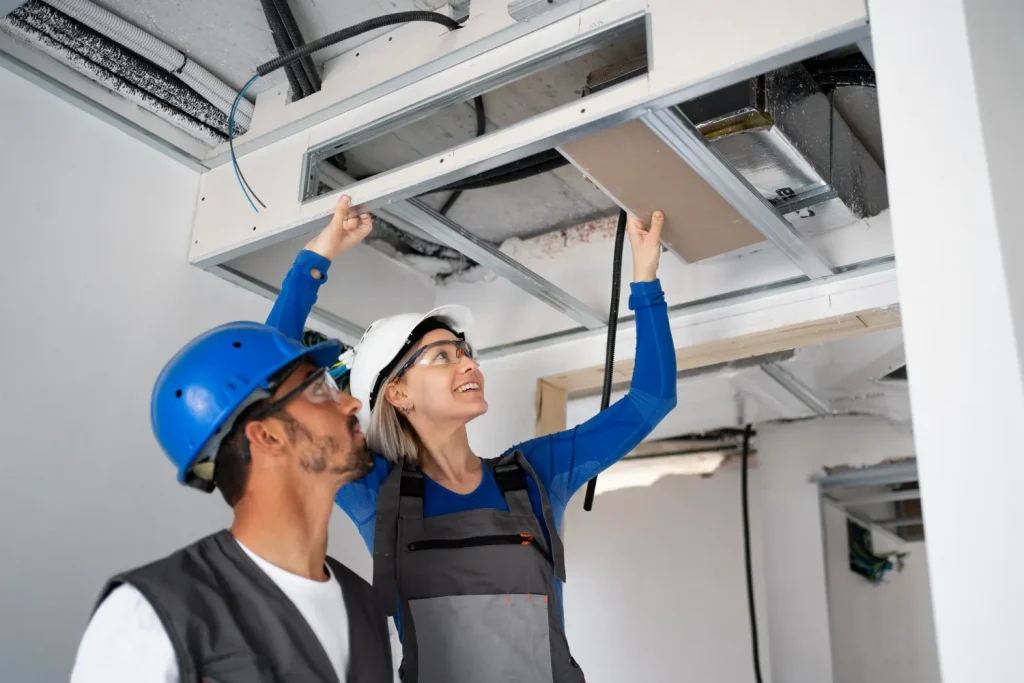
Electric heating systems have their own unique set of noises. Understanding these can help you troubleshoot effectively.
Popping or Cracking in Electric Furnaces
Electric furnaces heat air using heating elements rather than combustion. As these elements heat up and cool down, they expand and contract, causing popping sounds. This is usually normal, but excessive popping might indicate:
- Dirty heating elements
- Loose mounting hardware
- Elements that are wearing out and need replacement
Humming in Heat Pumps
Heat pumps are technically electric heaters that transfer heat rather than generate it. Common noises include:
- Low humming – Normal operation of the compressor
- Loud humming – Could indicate electrical problems or a struggling compressor
- Vibrating hum – Often caused by loose mounting hardware or refrigerant line issues
Buzzing from Electric Baseboards
Electric baseboard heaters are simple devices, but they can still be noisy:
- Expansion noise as metal heats up (normal)
- Buzzing from loose connections (needs attention)
- Popping from debris or dust burning off the elements
Why Is My Gas Heater Making Noise?
Gas heating systems involve combustion, which introduces different potential noise sources compared to electric heaters.
Rumbling After Burner Shutdown
A rumbling sound after your burners shut off often indicates:
- Dirty burners – Incomplete combustion creates rumbling as pockets of gas continue burning
- Flame sensor issues – A failing sensor might not shut off gas flow properly
- Delayed ignition – Gas buildup before ignition can cause ongoing rumbling
Whooshing Sounds
A gentle whoosh as your gas heater fires up is normal that’s the sound of burners igniting. However, loud whooshing or periodic whooshing can mean:
- Dirty air filters restricting airflow
- Undersized ductwork creating pressure issues
- Return air problems
Popping or Booming in Gas Furnaces
This is the most concerning noise in gas heaters. It typically means:
- Gas is building up before igniting (delayed ignition)
- Burners need cleaning
- Air-to-fuel ratio needs adjustment
Important: If you smell gas along with unusual noises, leave your home immediately and call your gas company.
DIY Solutions: How to Quiet Your Noisy Heater
“Common AC Repairs: What Every Homeowner Needs to Know”.
Many heater noise issues can be resolved with basic DIY maintenance. Here’s what you can safely do yourself:
1. Replace or Clean Your Air Filter
This simple fix resolves more issues than you’d think. A clogged filter makes your system work harder, creating more noise.
How to do it:
- Turn off your heating system
- Locate the filter (usually in the return air duct or on the furnace itself)
- Check if it’s disposable or reusable
- For disposable filters: Replace every 1-3 months
- For reusable filters: Rinse with lukewarm water, let dry completely before reinstalling
A clean filter improves airflow, reduces strain on your system, and often eliminates rattling or humming sounds.
2. Tighten Loose Components
Vibration is your heating system’s enemy. Over time, it loosens screws, panels, and connections.
What to check:
- Access panel screws
- Blower motor mounting bolts
- Duct connections near the furnace
- Vent covers and registers throughout your home
Pro tip: Use a screwdriver or wrench to systematically check and tighten any loose hardware. This 15-minute task can eliminate most rattling noises.
3. Clear Debris from Vents and Registers
Objects blocking your vents force air through smaller openings, creating whistling or howling sounds.
Quick inspection:
- Walk through your home checking each register
- Remove furniture, curtains, or items blocking airflow
- Remove vent covers and look for debris
- Vacuum out any dust or objects you find
4. Lubricate the Blower Motor (If Accessible)
Some older furnaces have blower motors with oil ports. Adding a few drops of machine oil can quiet squealing bearings.
Caution: Many modern motors are sealed and don’t require lubrication. Check your owner’s manual first, or you could damage your motor.
5. Check and Adjust Ductwork
If you have accessible ductwork in your basement or attic, you can often quiet banging sounds yourself:
Add duct insulation wrap where metal sections meet
Look for sections that appear loose or unsupported
Add metal straps or hangers to secure loose ducts
Insulate ducts to prevent expansion/contraction noise
“Duct sealing and insulation guide”
Advanced Sound Dampening Techniques
If basic fixes haven’t solved your noisy heater problem, these more advanced techniques can help:
Install Sound Dampening Insulation
Acoustic insulation around your heating unit and ductwork can significantly reduce noise transmission throughout your home:
- Wrap ductwork with insulation blankets designed for HVAC systems
- Install acoustic panels on walls near your furnace
- Add mass-loaded vinyl (MLV) barriers between your furnace room and living spaces
Seal Duct Leaks
Air leaks don’t just waste energy they create whistling sounds and increase overall system noise:
- Use mastic sealant (not duct tape!) on duct joints
- Apply foil tape to smaller gaps
- Seal around registers where they meet walls and floors
Add Vibration Isolation
Installing rubber pads or springs between your furnace and its mounting surface can dramatically reduce vibration noise:
- Rubber isolation pads go under the unit’s feet
- Spring isolators are more effective for severe vibration
- Flexible duct connectors between your furnace and ductwork prevent vibration transfer
Strategic Furniture Placement
This might sound simple, but it works:
- Place bookshelves against walls shared with your furnace room
- Use thick area rugs near noisy ducts
- Hang heavy curtains or tapestries to absorb sound
- Position upholstered furniture strategically to dampen noise
When to Call a Professional for Your Noisy Heater
While DIY fixes work for many situations, some noisy heater problems require professional expertise. Here’s when to pick up the Phone and call: (480) 772-0229
Emergency Furnace Repair Winter Services
Immediate Professional Help Needed:
- You smell gas – This is a genuine emergency. Leave immediately and call your gas company
- Loud banging or booming that’s getting worse – Could indicate dangerous pressure issues or imminent component failure
- Continuous squealing that doesn’t stop – Suggests bearings are completely failed and components could seize
- Burning smell with noise – Might indicate electrical problems or overheating
- Carbon monoxide detector alarm – Evacuate and call 911 immediately
Schedule Service Soon:
- Humming that suddenly got louder (electrical issues developing)
- New rattling sounds after basic fixes (internal component problems)
- Clicking that won’t stop (ignition system failing)
- System is short-cycling (turning on and off repeatedly)
- Noise accompanies reduced heating performance
Benefits of Professional Diagnosis
When you call an HVAC technician like those at AZ AC And Heat Services, you get:
- Comprehensive system inspection – Professionals can spot problems you might miss
- Specialized tools and equipment – Proper diagnostic equipment identifies issues accurately
- Safety expertise – Technicians know how to safely work with gas, electricity, and high-pressure systems
- Warranty protection – DIY repairs might void manufacturer warranties
- Long-term solutions – Fixes are done right the first time, preventing repeat issues
Cost Considerations
Many homeowners hesitate to call professionals because of cost concerns. However, consider this:
- A service call typically costs $75-$150 in the Tempe area
- Simple repairs might cost $150-$400
- Ignoring problems often leads to complete system failure ($3,000-$7,000 for replacement)
- Professional maintenance extends equipment life by 3-5 years on average
- Proper repairs improve efficiency, reducing monthly energy bills
The math usually favors calling a professional before a minor issue becomes a major expense.
Preventive Maintenance: Stop Noises Before They Start
The best approach to a noisy heater is preventing the noise in the first place. Here’s a comprehensive maintenance schedule:
Monthly Tasks (During Heating Season)
- Check and replace air filters as needed
- Listen for new or changing sounds
- Ensure vents and registers are unobstructed
- Look for visible signs of wear or damage
Seasonal Tasks (Before Winter)
- Schedule professional inspection and tune-up
- Clean around outdoor heat pump units
- Test your thermostat accuracy
- Check pilot light (gas heaters) or heating elements (electric)
- Inspect ductwork for visible damage or disconnections
Annual Professional Maintenance
A yearly professional tune-up should include:
- Complete system inspection
- Burner cleaning and adjustment (gas systems)
- Electrical connection testing
- Blower motor lubrication and inspection
- Safety control testing
- Combustion analysis (gas systems)
- Refrigerant level check (heat pumps)
- Ductwork inspection
Investment perspective: Annual maintenance costs $100-$200 but can prevent 95% of heating system failures, saving you thousands in emergency repairs. ( Is It Necessary to Service AC Every Year )
Upgrading Your Heating System: When Replacement Makes Sense
Sometimes, a noisy heater is telling you it’s time for retirement. Here’s how to know when upgrading makes more sense than repairing:
Signs It’s Time to Replace Your Heating System
- Age over 15-20 years – Older systems are less efficient and more prone to expensive repairs
- Frequent repairs – If you’re calling for service multiple times per year, replacement often costs less over time
- Rising energy bills – Older, worn systems work harder and use more energy
- Uneven heating – Struggling systems can’t maintain consistent temperatures
- Multiple noise sources – When several components are failing simultaneously, replacement is more economical
Benefits of Modern Heating Systems
Today’s heating equipment offers significant advantages:
- Quieter operation – Variable-speed motors and better insulation make new systems much quieter
- Energy efficiency – Modern systems use 20-40% less energy than systems from the 1990s
- Better comfort – Multi-stage heating and smart thermostats provide consistent comfort
- Improved air quality – Advanced filtration systems remove more allergens and pollutants
- Smart home integration – Control your heating remotely and optimize schedules automatically
What to Ask When Buying a New HVAC System
Choosing the Right Replacement
When selecting a new heating system, prioritize:
- Proper sizing – An oversized or undersized system will be noisy and inefficient
- Energy efficiency ratings – Look for high AFUE (gas) or HSPF (heat pump) ratings
- Variable-speed technology – These systems run more quietly and efficiently
- Quality installation – Even the best equipment performs poorly with bad installation
- Warranty coverage – Protect your investment with comprehensive warranties
Work with experienced professionals like AZ AC And Heat Services to ensure your new system is correctly sized, properly installed, and perfectly suited to Tempe’s climate.
Real Stories from Tempe Homeowners
Understanding common heater noise problems becomes clearer when we hear from people who’ve dealt with them. Here are some real experiences from local residents:
The Banging Ductwork Mystery
Sarah from South Tempe dealt with loud banging every time her heater started up. “It sounded like someone was hitting the ducts with a hammer,” she recalls. After calling a technician, she discovered her ductwork was undersized for her system.
The intense pressure difference caused the metal to flex violently. Adding a few extra return air vents and securing loose duct sections eliminated the problem completely.
The 3 AM Squealing Wake-Up Call
Mike’s heat pump started making a horrible squealing sound in the middle of the night. “I thought something was dying in my walls,” he laughs. The culprit? Worn blower motor bearings. A quick replacement of the motor not only eliminated the noise but actually improved his heating efficiency. His energy bills dropped 15% afterward.
The Mysterious Humming
Jennifer noticed her electric furnace started humming loudly, especially in the evening. She tried DIY fixes changing filters, tightening panels but nothing worked.
A professional inspection revealed a failing capacitor that was on the verge of complete failure. Replacing it before it died completely saved her from a cold night without heat and potential damage to her blower motor.
These stories share a common thread: addressing noisy heater issues early prevents more significant problems and expensive emergency repairs.
Frequently Asked Questions About Noisy Heaters
Why is my heater making noise when I first turn it on?
Some noise when your heater first starts is completely normal. You’ll typically hear a gentle whoosh as burners ignite or a brief hum as the blower motor spins up. However, loud banging, scraping, or persistent rattling indicates a problem.
This startup noise often comes from expansion contraction as components heat up, dust burning off after months of inactivity, or a system that needs lubrication.
Is it normal for my heater to make popping sounds?
Occasional popping as your ductwork expands and contracts is normal and harmless. However, frequent or loud popping especially from a gas furnace can signal delayed ignition, which is a safety concern.
If popping sounds happen every time your system runs or are getting progressively louder, have a professional inspect your system.
Why does my heater make noise at night but not during the day?
This is surprisingly common and usually relates to temperature differentials. At night, when your home cools down significantly, the temperature difference between your ductwork and the surrounding air is greater, causing more pronounced expansion and contraction.
Additionally, ambient noise from traffic, household activities, and neighborhood sounds is lower at night, making heater noises more noticeable.
Finally, some thermostats are programmed to work harder at night to maintain temperature, potentially running the system more frequently.
Can a noisy heater be dangerous?
Most heater noises are annoying but not dangerous. However, certain sounds require immediate attention for safety reasons. Loud banging in gas furnaces can indicate delayed ignition, creating a risk of gas buildup. for more information ( Carbon monoxide safety tips )
Persistent clicking from the igniter suggests incomplete combustion. Any noise accompanied by a gas smell, burning smell, or carbon monoxide detector activation is a serious safety concern requiring immediate professional attention.
How much does it cost to fix a noisy heater?
Repair costs vary widely depending on the issue. Simple fixes like replacing an air filter or tightening loose components might cost nothing if you DIY, or $75-150 for a service call. Mid-range repairs like replacing a blower motor or capacitor typically run $200-500.
Major repairs like replacing a heat exchanger or entire blower assembly can cost $800-1,500. Preventive maintenance ($100-200 annually) is always cheaper than emergency repairs.
Will a noisy heater increase my energy bills?
In many cases, yes. A heater making unusual noises is often working harder than it should, which means it’s using more energy. Clogged filters force your system to run longer to heat your home.
Loose or leaky ductwork wastes heated air. Failing motors draw more electricity as they struggle. Addressing the source of the noise often improves efficiency and reduces your monthly energy costs by 10-30%.
Why is my heater so loud compared to my neighbor’s?
Several factors affect heating system noise levels. The age of your system plays a major role older equipment is inherently louder. The type of heating system matters too (forced air systems are generally noisier than radiant heat). Installation quality makes a huge difference; poorly installed systems with inadequate vibration isolation or undersized ductwork will be much louder. Finally, maintenance history affects noise well-maintained systems stay quieter longer.
Can I use my heater if it’s making noise?
For most noises rattling, humming, or occasional banging you can safely continue using your heater while you schedule a repair. However, certain sounds demand immediate shutdown. Turn off your heater immediately if you hear scraping or grinding metal (suggests moving parts are hitting each other), smell gas alongside unusual noises, hear continuous loud squealing (bearings have completely failed), or notice smoke or burning smells with the noise. When in doubt, err on the side of caution and shut down your system.
Take Control of Your Noisy Heater Today
Living with a noisy heater doesn’t just disrupt your peace and comfort it’s often a sign that your system needs attention. Whether you’re dealing with banging ductwork, a humming blower motor, or mysterious sounds when your heater is off, taking action now prevents bigger problems down the road.
Start with the simple DIY solutions we’ve covered: change your filter, tighten loose components, and clear obstructed vents. These basic steps resolve the majority of common heater noises without spending a dime. However, if the noise persists or you’re experiencing any of the warning signs we’ve discussed, don’t hesitate to bring in a professional.
For Tempe residents, AZ AC And Heat Services offers comprehensive heating system diagnostics, repairs, and maintenance.
Our experienced technicians can quickly identify the source of your noisy heater and provide lasting solutions that restore quiet operation and optimal efficiency.
Remember, your heating system is an investment in your home’s comfort and value. Regular maintenance, prompt attention to unusual sounds, and professional service when needed will keep your system running quietly and efficiently for years to come.
Don’t let another sleepless night or stressful day pass with that persistent heating noise take action today to restore peace and warmth to your Tempe home.
Ready to silence your noisy heater? Contact AZ AC And Heat Services for expert diagnosis and repair. Our local technicians: Phoenix
Queen Creek understand Arizona’s unique climate demands and can quickly resolve any heating issue, restoring comfort to your home.